

Nick Clegg, the former Deputy Prime Minister of the UK and now president of global affairs at Meta, recently discussed the expanding influence of Elon Musk in U.S. politics and social media. Speaking on the Political Thinking podcast, Clegg expressed concerns about Musk’s growing role in shaping the U.S. political landscape, particularly his influence on the upcoming U.S. elections and the formation of the new Trump administration.
Nick described Musk’s potential future influence as a “political puppet master,” suggesting that Musk, with his significant wealth and influence, could play an outsized role in deciding who the Republican Party nominates for the next presidential election and beyond.
While Clegg acknowledged that wealthy individuals have always had some degree of influence in U.S. politics, he warned that Musk’s increasing control over the direction of the Republican Party is a new development, one that moves beyond the traditional model of political engagement seen in American democracy.

Clegg’s comments come as Musk has taken an active role in reshaping X (formerly Twitter), the social media platform he purchased in 2022. Musk has positioned himself as an advocate for freedom of expression, taking steps to dismantle the platform’s previous content moderation policies and promote a more open approach to communication. In contrast, Clegg’s role at Meta, where he oversees global policy and communication, is centered on finding a balance between protecting users from harmful content while upholding the principles of free speech.
He expressed concerns that Musk’s approach to content moderation on X could lead to a platform dominated by hyper-partisan views, calling it a “one-man, hyper-partisan, ideological hobbyhorse.” This reflects the growing tensions between the two tech giants, with Clegg representing Meta’s efforts to address harmful content and misinformation, while Musk pushes for more freedom of expression without what he sees as the constraints of censorship.
In discussing Musk’s potential to influence the political scene, Clegg emphasized that Musk’s growing power could reshape the Republican Party and, more broadly, American politics. He noted that the tech billionaire could either continue to support candidates or become a “puppet master,” effectively determining the future of the party and who would be best suited to lead it.
Clegg’s concern is that this level of influence—far beyond the usual donations or support given by wealthy individuals—could have unforeseen consequences for American democracy. He pointed out that the public is more accustomed to wealthy individuals contributing to political campaigns, but Musk’s increasing ability to directly shape the political landscape represents a shift that could complicate democratic processes in ways not seen before.
At the same time, Clegg offered his perspective on the role of emerging technologies, specifically artificial intelligence (AI), in the political discourse. He took aim at what he sees as exaggerated fears surrounding AI’s potential to undermine democracy. Clegg mocked the idea that AI could result in mass destruction, such as turning people into “paperclips,” and argued that concerns over AI’s impact on democracy were overstated.
He acknowledged that AI could be misused to create deepfakes and spread misinformation, but he also emphasized that AI’s overall impact has not been as destructive as some had feared. For Clegg, the primary focus should be on addressing real-world issues, such as child sex abuse, deepfakes, and disinformation, rather than getting bogged down in speculative fears about AI.
In his role at Meta, Clegg also faced criticism regarding the company’s handling of harmful content on its platforms, particularly in relation to the safety of children online. He admitted that no company is doing enough to address these issues, but he emphasized the importance of ongoing efforts to improve how children interact with technology.
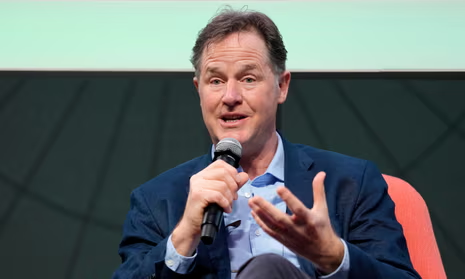
As smartphones and social media platforms continue to grow in influence, Clegg suggested that companies like Meta must remain vigilant in addressing the risks that accompany these technologies. His remarks reflect the ongoing challenges faced by social media companies in striking a balance between freedom of speech and the protection of vulnerable users from harmful content.
Clegg’s position at Meta gives him a unique perspective on the challenges facing both the tech industry and society at large. As the debate over social media regulation, misinformation, and political influence continues to evolve, his comments serve as a reminder of the complex intersection between technology, politics, and public safety. While Musk’s influence grows and his stance on censorship raises questions about the future of social media, Clegg’s approach seeks to strike a delicate balance, addressing harmful content while respecting free speech.
He’s comments offer a thoughtful reflection on the shifting dynamics of U.S. politics, social media, and the role of powerful individuals like Musk in shaping these spheres. While his focus remains on mitigating harm and safeguarding democracy, the increasing concentration of power in the hands of a few individuals raises critical questions about the future of both American politics and the tech industry. As Musk’s influence grows, the implications for both political and social discourse will likely continue to unfold in the coming years.