

The memorial service for Charlie Kirk drew tens of thousands of people to Arizona’s State Farm Stadium, a space usually reserved for football games and concerts, but on this day transformed into a place of mourning and remembrance. The crowd reflected just how deeply Kirk’s presence had resonated within political and cultural circles.
Supporters, friends, and high-profile political figures all arrived to honor a man many described as a fighter for his beliefs, someone whose voice had helped shape conversations on conservatism and freedom. The atmosphere was heavy with both grief and symbolism, as Kirk’s tragic death at just 40 years old had shocked followers and critics alike.
Security at the venue was notably tight, underscoring the magnitude of the event and the stature of the guests in attendance. Donald Trump, the former president, arrived to lead the tributes, reminding the audience of Kirk’s devotion to causes he considered vital for the future of the United States.

Sitting among the crowd were senators, governors, and influential figures, including JD Vance and Marco Rubio, who both offered speeches lauding Kirk’s commitment and courage. For them, this was more than just a farewell; it was an affirmation of the principles Kirk had lived by.
Yet, beyond the solemn tributes and emotional recollections, the service became the stage for a moment that captured the attention of millions worldwide. Donald Trump and Elon Musk, two of the most prominent and polarizing figures in modern American life, appeared to publicly reconcile after months of bitter disputes and highly publicized disagreements. Their interaction quickly became one of the most talked-about elements of the day, overshadowing even some of the speeches.
The history of tension between Trump and Musk had been building for years. Musk had been critical of Trump’s administration at various points, even stepping away from advisory positions in government after policy disagreements. More recently, Musk accused Trump of deliberately sabotaging reform efforts and ridiculed his approach to leadership. Trump, for his part, had mocked Musk in speeches and on social media, dismissing his business ventures and questioning his reliability. Their back-and-forth exchanges had painted a picture of a rift too wide to bridge.
That perception shifted during the funeral. Cameras caught the two men shaking hands and leaning in close during their conversation, their body language markedly different from the hostility often on display in their past remarks. Later analysis added another dimension to the story.
A professional lip reader reviewed footage from the event and claimed that Trump had spoken reassuring words to Musk, telling him, “All good,” and signaling a desire to move forward. To UFC president Dana White, who was also seated nearby, Trump reportedly added, “Let’s try and work out how to get back on track. I’ve missed you.”
The apparent truce was not just confined to whispers caught by attentive observers. Musk himself seemed eager to signal reconciliation, posting a photo of him standing beside Trump with a short caption that read, “For Charlie.” The words suggested that, at least for the day, the disagreements between them were set aside in order to honor a shared friend.
Trump’s speech at the memorial was also a subject of conversation, not only because of his tribute to Kirk but because of its unexpected diversions. At one point, he shifted to discuss autism, a tangent that surprised many attendees given the gravity of the event. Still, he returned to the central theme of celebrating Kirk’s life and described him as a martyr for freedom, someone who had given everything for the causes he believed in.
The emotional weight of the day was intensified by the circumstances surrounding Kirk’s death. He had been killed on September 10 in what authorities described as a deliberate act of violence. A 22-year-old named Tyler Robinson was charged with aggravated murder in connection to the crime.
The shocking nature of the incident left supporters reeling, turning the memorial into not only a celebration of Kirk’s life but also a moment of reckoning with the fragility of existence and the dangers faced by public figures who attract strong devotion and equally strong opposition.
For those gathered in the stadium, the service carried multiple layers of meaning. It was, first and foremost, a farewell to a man remembered for his passion and commitment. It was also a political moment, a demonstration of unity among figures who often clash but who shared a common bond through Kirk. And, in the unexpected handshake and whispered reconciliation between Trump and Musk, it became a symbol of how grief and remembrance can sometimes pave the way for bridges to be rebuilt.
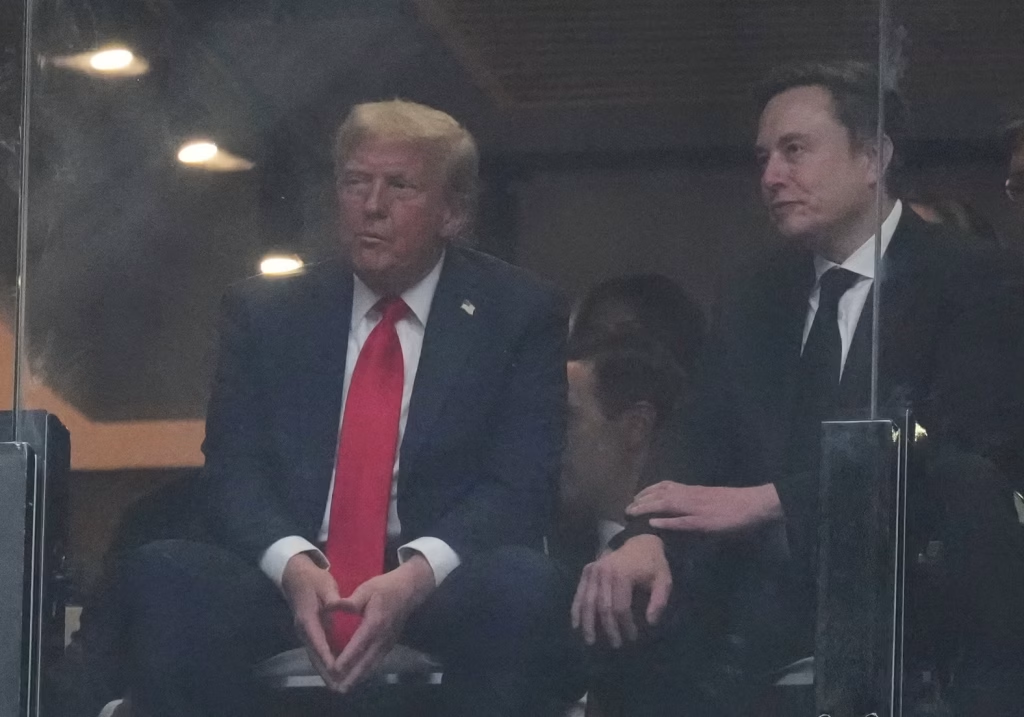
The audience, which included everyday supporters as well as prominent leaders, witnessed something that was both deeply personal and unavoidably public. Mourning and politics often intertwine, but rarely do they produce moments of reconciliation that reverberate so quickly across news cycles and social media. The photo Musk shared and the words Trump reportedly spoke will likely be dissected for weeks to come, interpreted by some as a genuine truce and by others as a temporary pause in an ongoing rivalry.
In the end, the service was a reminder of the complex intersections of personal loss, political life, and public spectacle. Charlie Kirk’s death left a void among those who championed his ideas, and his memorial became more than a ceremony of mourning.
It was a stage where grief met politics, where old adversaries put aside differences—if only briefly—and where thousands gathered to say goodbye to a man whose impact had been undeniable. At least for that day, the narrative was not about division but about shared remembrance, and about the possibility, however fragile, of moving forward together.
